,c]tifica;n
Certification
The National Braille Association (NBA) is the only organization to offer a certification identifying a transcriber’s proficiency in applying the Braille Formats: Principles of Print to Braille Transcription, 2016, as published by the Braille Authority of North America (BANA).
Braille Formats Certification
The Braille Formats Certification Exam is a test of a transcriber’s ability to properly apply the Formats guidelines to transcription projects.
To qualify for certification in Braille Formats, transcribers must first be certified by the National Library Service (NLS) in Literary Braille Transcription or by the CNIB Foundation. Information on the NLS certification can be found here, and information on the CNIB certification can be found here.
Having the most current certification in a specific area can be attractive to a potential employer. Some employers may even require that you obtain the most current certification. But it is NBA’s belief that someone who has obtained a certification in Braille Formats 2011 and a Letter of Proficiency in Unified English Braille has adequately demonstrated their ability to accurately transcribe textbooks into braille according to the latest codes and standards.
About The Exam
The Braille Formats certification exam is completed by mailing the test materials. Those seeking to become certified will complete an application form, and submit the form with payment. The exam taker (or proctor) will then receive a version of NBA’s own mini-textbook through the mail.
Individuals have eight weeks to complete transcription of this sample textbook and return all materials. Upon receipt, a grade accompanied by an error report will be returned to the exam taker within one month.
Grades of 80 or higher will be awarded certification. Grades below 80 will be documented as a failed attempt at certification. Any exam taker receiving a failing grade on their first attempt make retake the exam right away. The process for a second attempt at certification is identical to the initial application process.
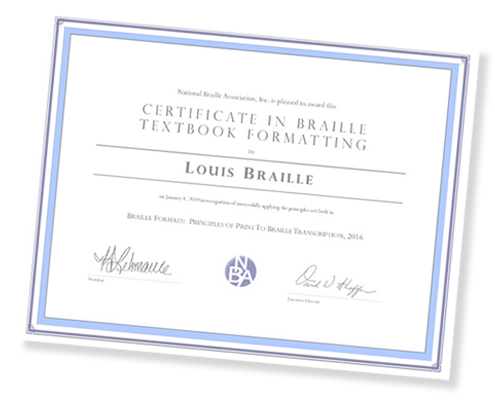
Individuals who successfully certify are given an electronic certificate and are listed on our website as evidence of their proficiency in the current code.
Quick Facts
- The cost of the exam is $175.00
- Individuals have eight weeks to return the completed exam back to NBA from the date they were received
- Submitted materials must be in simbraille with numbered lines, in portrait oriented printing
- The exam is open book so you may reference codes or study materials, but consulting with other individuals is prohibited
Resources
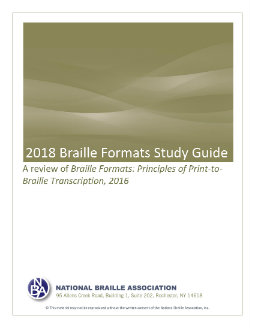
In addition to the guidelines available from the BANA website, we have written and published the 2018 Braille Formats Study Guide to help you familiarize yourself with the guidelines and its application prior to taking the exam. Purchase of the study guide is not required for certification, but many exam takers find it helpful in learning the material and applying its concepts.
Current NBA members have full access as no additional cost to a newer version of the Study Guide in our Learning Management System (LMS). The LMS version allows users to walk through study material using interactive questions and even allows you to enter braille and check it as you go. For those that don't want to be a member the Study Guide is available for purchase in our online store in hardcopy print, ebook, electronic braille, and hardcopy braille.
In addition to these materials, NBA has published a number of publications to help learn the intricacies of the Braille Formats code. These publications are available in our website store.
NBA has producing free webinars since 2016 on a range of topics, including Braille Formats. Attendance at our webinars are free and open to all. Recordings from all of our webinars is accessible to current NBA members in the archive.